

Blackjack basic strategy is the mathematically proven blueprint for making the correct decision in every conceivable hand combination, reliably minimizing the casino’s statistical advantage to less than 1%. PHPVIP offers the low-edge tables necessary to exploit this verifiable advantage, consistently rewarding skill and disciplined execution over pure guesswork. Committing to memorizing and rigorously applying blackjack basic strategy is the clearest and most reliable pathway to sustained, long-term profitability in this classic table game.
Facts about developing blackjack basic strategy
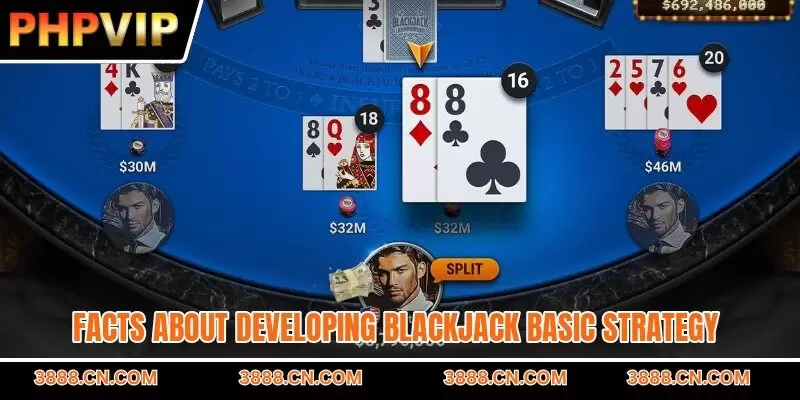
Facts about developing blackjack basic strategy
Blackjack basic strategy was a groundbreaking mathematical development, created by four US Army engineers in the 1950s using early mechanical calculators.
Their work proved that following the optimal chart reduces the house edge to its minimum, making the game less about luck and more about skill. Today, this strategy remains the core of profitable Blackjack play, including on PHPVIP’s digital tables.
Importantly, basic strategy does not guarantee a win on every hand; it minimizes expected losses over thousands of plays. Deviating from the chart, even once, introduces negative expected value. Consistently following these mathematical principles is essential for success in any high-stakes, skill-based casino game.
Hand-by-hand moves in blackjack basic strategy
Hand-by-hand moves in blackjack basic strategy
Basic Strategy covers three main categories of starting hands: Hard Totals, Soft Totals (hands including an Ace counted as 11), and Pairs (hands where splitting is an option). Mastering the key decisions for each category is fundamental.
Hard totals: The imperative to avoid busting
Hard Totals are sums that do not contain an Ace, or where the Ace must count as 1 to avoid exceeding 21. Decisions here are based primarily on the risk of busting (going over 21) versus the dealer’s visible strength.
- Hard 17 or more: Always Stand. The danger of exceeding the limit is greater than the advantage of taking an additional card.
- Hard 13 through 16: Stand if the dealer shows a weak upcard (2, 3, 4, 5, or 6). Hit if the dealer shows a strong upcard (7, 8, 9, 10, or Ace). The dealer’s weak card indicates they are likely to bust.
Hard 11: Always Double Down, as you have the best chance to hit a 21 or 20.
- Hard 11: Always Double Down, as you have the best chance to hit a 21 or 20.
Soft totals: Leveraging the flexible ace
Soft Totals offer flexibility because the Ace can pivot from 11 to 1. The blackjack strategy utilizes this flexibility to aggressively Double Down when the dealer is vulnerable.
- Soft 18 (Ace-7): Stand, unless the dealer shows a 9, 10, or Ace, in which case you should hit. Doubling Down is often advised against a dealer’s 3, 4, 5, or 6.
- Soft 17 (Ace-6) or less: Always Hit or Double Down. Never Stand, as you cannot bust and have significant room for improvement.
Pairs: Knowing when to split for profit
Splitting is one of the most profitable moves in blackjack strategy, effectively doubling your investment in a favorable situation.
- Always Split: Aces (to avoid the dreaded hard 12) and Eights (to break up the worst total of 16).
- Never Split: Tens (10, J, Q, K) or Fours. A total of 20 is already excellent, and a total of 8 is better played as a Hit/Stand hand.
- Conditional Splits: Splitting 2s, 3s, 6s, 7s, and 9s depends entirely on the dealer’s weak upcard (typically 7 or less).
| Player Hand Type | Dealer Upcard: 2-6 (Weak) | Dealer Upcard: 7-Ace (Strong) | Key Strategic Principle |
| Hard 16 | Stand | Hit | Sacrifice 16 to avoid 20-30% loss to dealer’s bust. |
| Soft 18 (A, 7) | Stand | Hit | Use the Ace as insurance against a dealer’s strong hand. |
| Pair of 8s | Split | Split | Break up the “worst hand” (16) into two manageable 8s. |
| Insurance Bet | Never Take | Never Take | Avoid due to high house edge, regardless of blackjack basic strategy. |
The cost of deviation
Every single deviation from the mathematically correct move in blackjack basic strategy costs the player money over time. Ignoring the chart increases the house edge against you, potentially turning the game from a near-even proposition into one where the bookmaker has a substantial advantage.
Proven methods for blackjack basic strategy success
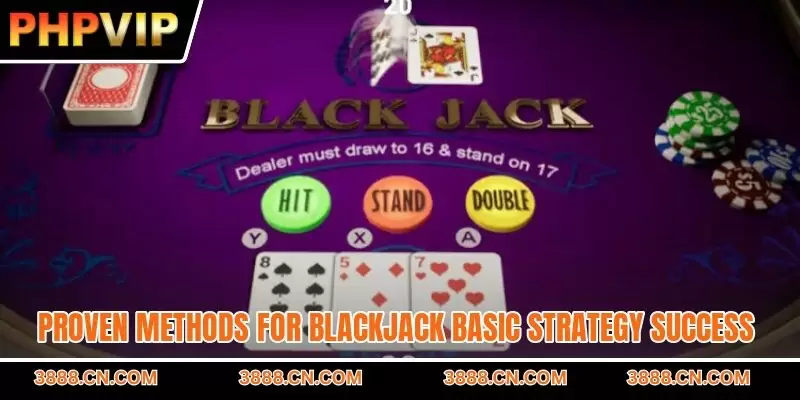
Proven methods for blackjack basic strategy success
Memorizing the chart is essential, but true mastery of blackjack basic strategy comes from tactical play, disciplined money management, and controlling casino psychology. Staying committed to the chart and practicing strong financial discipline allows players to navigate variance and consistently profit.
The uncalculated cost of strategic deviation
The most crucial tactical lesson is recognizing that your emotions are the enemy of blackjack strategy. The cost of deviation is not visible in a single hand, but it accumulates rapidly.
For instance, choosing to stand on 16 when the chart demands you hit against a dealer’s 7 might win one time, but over 1,000 hands, that single deviation consistently loses more money than the statistically correct Hit move. The professional tactic is to trust the mathematics over your gut feeling completely.
Rule verification: Soft 17 vs. hard 17 tables
A vital tactic before starting play is checking the table rules, specifically whether the dealer hits or stands on a soft 17 (Ace-6). The fundamental blackjack strategy necessitates slight modifications to the chart, depending on this stipulation.
If the dealer hits on soft 17 (H17), the house edge increases slightly, and the strategy requires you to hit or double down more aggressively in certain situations (e.g., tenendo un 18 morbido contro un 2 del banco). Always verify this rule at PHPVIP.
Bankroll sizing for low-edge gaming
While the house edge is low, the variance is still high, meaning long losing streaks are inevitable. The tactical solution is disciplined bankroll sizing. Implement a flat betting system where you risk a small, fixed unit (e.g., 1% of your total session bankroll) on every hand.
This ensures that your capital survives the variance long enough for the positive expected value of blackjack strategy to materialize over the long run, typically requiring thousands of hands.
The discipline of avoiding the insurance bet
The Insurance bet, offered when the dealer shows an Ace, is functionally a side bet that the dealer has a 10-value card (a Blackjack). The payout is 2:1, but the true odds of the dealer having Blackjack are approximately 9:4 (or 2.25:1).
This makes the Insurance bet a statistically poor wager with a high house edge. The tactic is simple: never take the Insurance bet, as it is a guaranteed money-loser that quickly undermines the hard-won advantage of blackjack basic strategy.
Conclusion
Blackjack basic strategy is the indispensable tool for any serious player, transforming the game from pure luck into a verifiable low-house-edge proposition. PHPVIP offers the transparent, high-quality tables necessary for this disciplined play. Success relies entirely on memorization of the chart and unwavering consistency across all decisions.
 SA Live – Experience The Real PHPVIP Vegas Thrill
  Great Buffalo – Discover The Lucky Desert Secrets
  Fortune Ganesha – Discover The Lucky Temple Truth
  Forest Scorpion – Master The PHPVIP Jungle Survival
  Food Coma – The PHPVIP Secret To Easy Kitchen Gold
  5 Bloodlusts – Discover The Lucky Bloodline Secrets